[This article is written by Ms Khong Loan - Women In Tech and Women Tech Entrepreneurs Advisor]
Today, I was deeply honored to share at the Women in Business event focused on Inclusive Growth, organized by ECCE and Women in Tech, together with Canadian Consul Annie Dube, British Consul Alexandre Smith, and leaders from many organizations such as KPMG, Sharework, The New Leaders, and others.
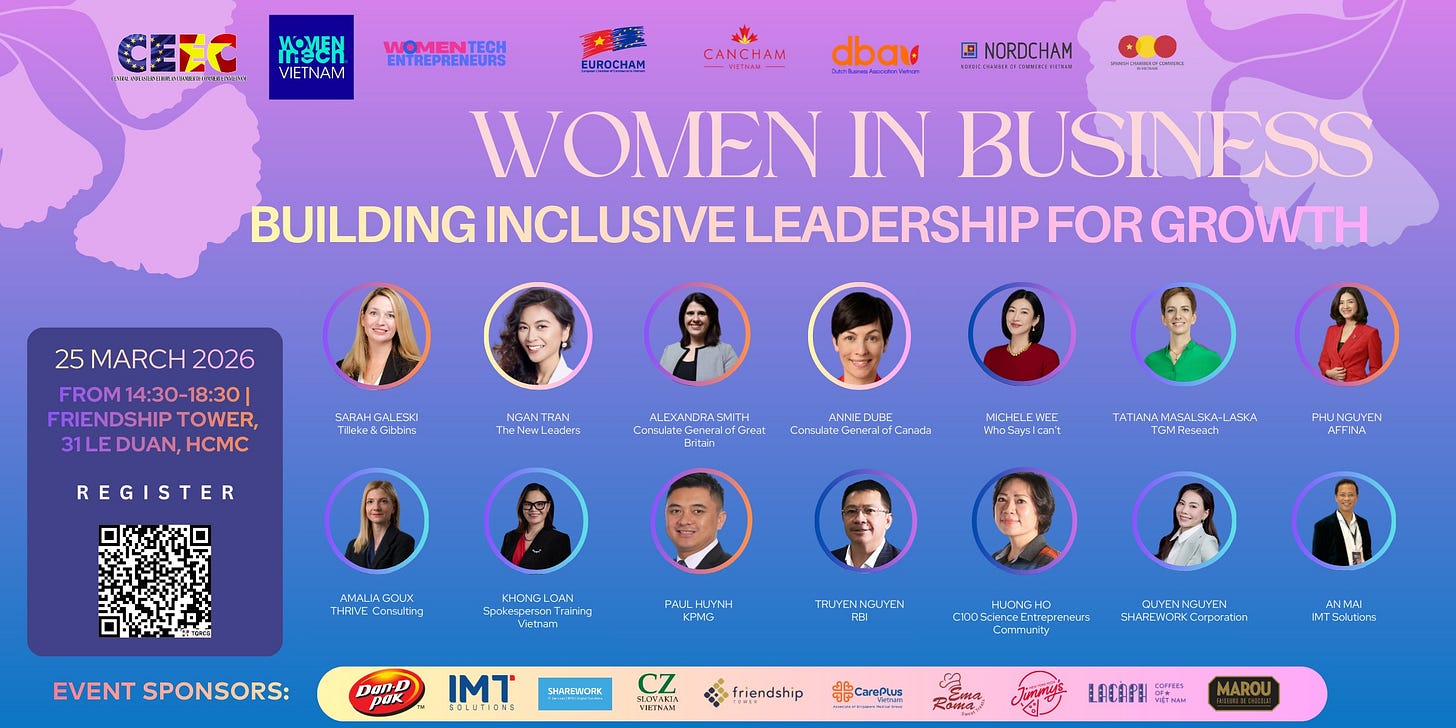
In the panel discussion moderated by Canadian Consul Annie Dube, under the theme “How can we avoid losing female talent in the middle layer of organizations?”, I had the opportunity to listen to the perspectives of Ms. Huong Ho, former Director of VinFast Europe, and Ms. Michele Wee, former CEO of Standard Chartered Bank Vietnam. They and I are all advisors to Women in Tech Vietnam, a non-profit organization with the mission of supporting women’s career development in the technology sector.
There were three key points I shared in response to Consul General Annie Dube’s questions:
1. When organizations lose female talent in the “middle layer” — the mid-management level — it is a significant loss. This makes the goals of inclusive growth and increasing the number of women in senior leadership positions even more distant.
(Even though Vietnam performs relatively well in terms of the proportion of female leaders in small and medium enterprises — around 33% compared to the global average of approximately 30% — source to be updated.)
Imagine a bridge with its middle span removed. Reaching the top becomes extremely difficult, if not impossible. If there is nothing in the middle, how can there be a peak? That is why female CEOs in big corps remain rare — this is simply reality. However, science has consistently shown that the presence of women in leadership benefits everyone.
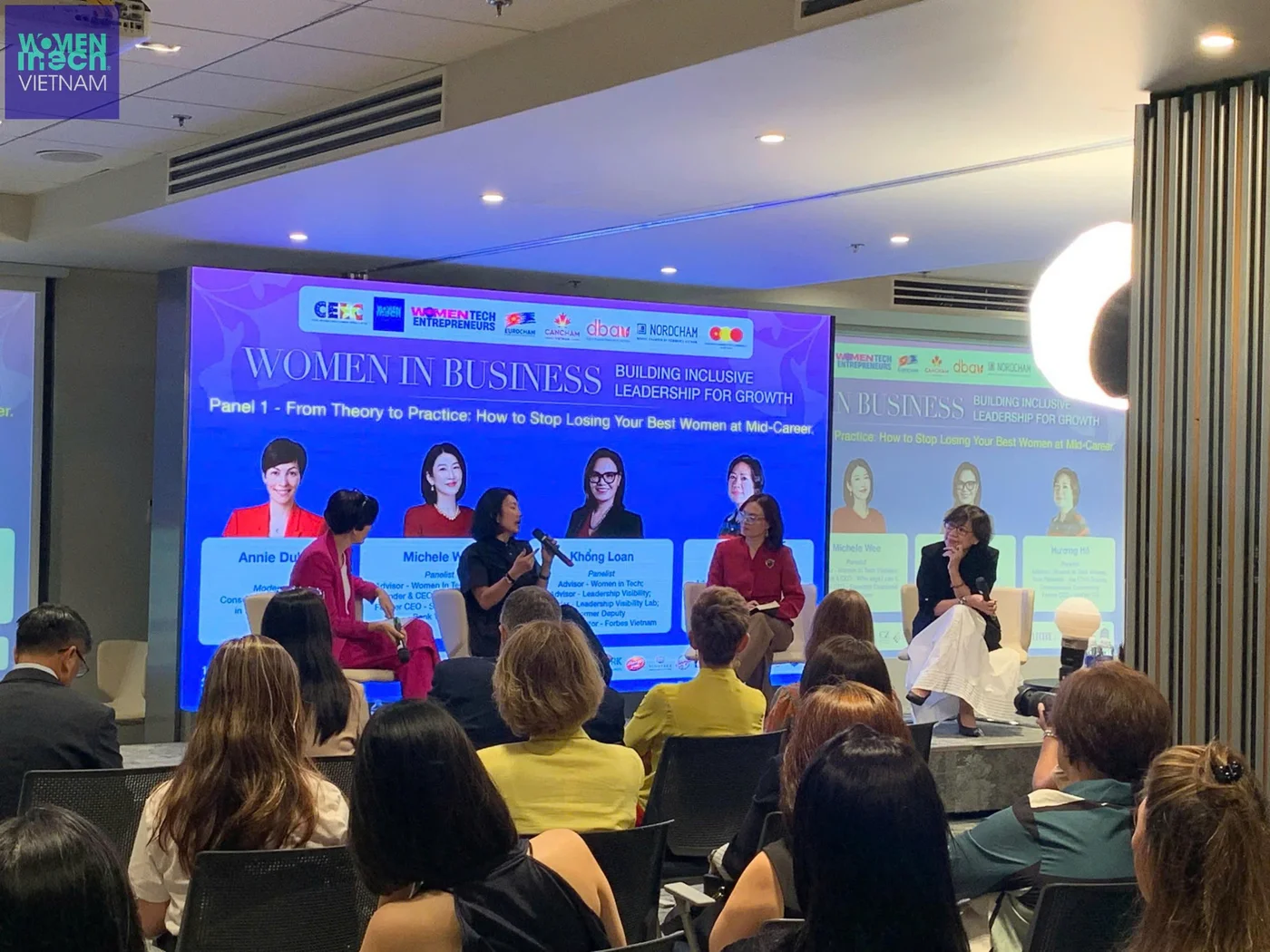
2. The female leaders I currently advise on leadership presence are truly outstanding. What they often lack is not capability, but the right kind of presence to be seen, recognized, and valued in alignment with their true leadership spirit.
Our society still carries many biases (again, this is factual) and outdated beliefs. Two particularly systemic and cultural beliefs stand out:
“Just do the work, and people will eventually see your value and evaluate you fairly.” This is wrong. First, no one is really watching — everyone is too busy looking at themselves in the mirror. And if you do not shape your narrative, others will tell it for you, based on their own interpretations — and most of the time, it will not align with how you want to be seen.
“You shouldn’t talk about what you’ve achieved, because that would be showing off or lacking humility.” This is also wrong. When presence is done thoughtfully, strategically, and effectively, the benefits extend beyond the individual — they benefit the organization and even the country.
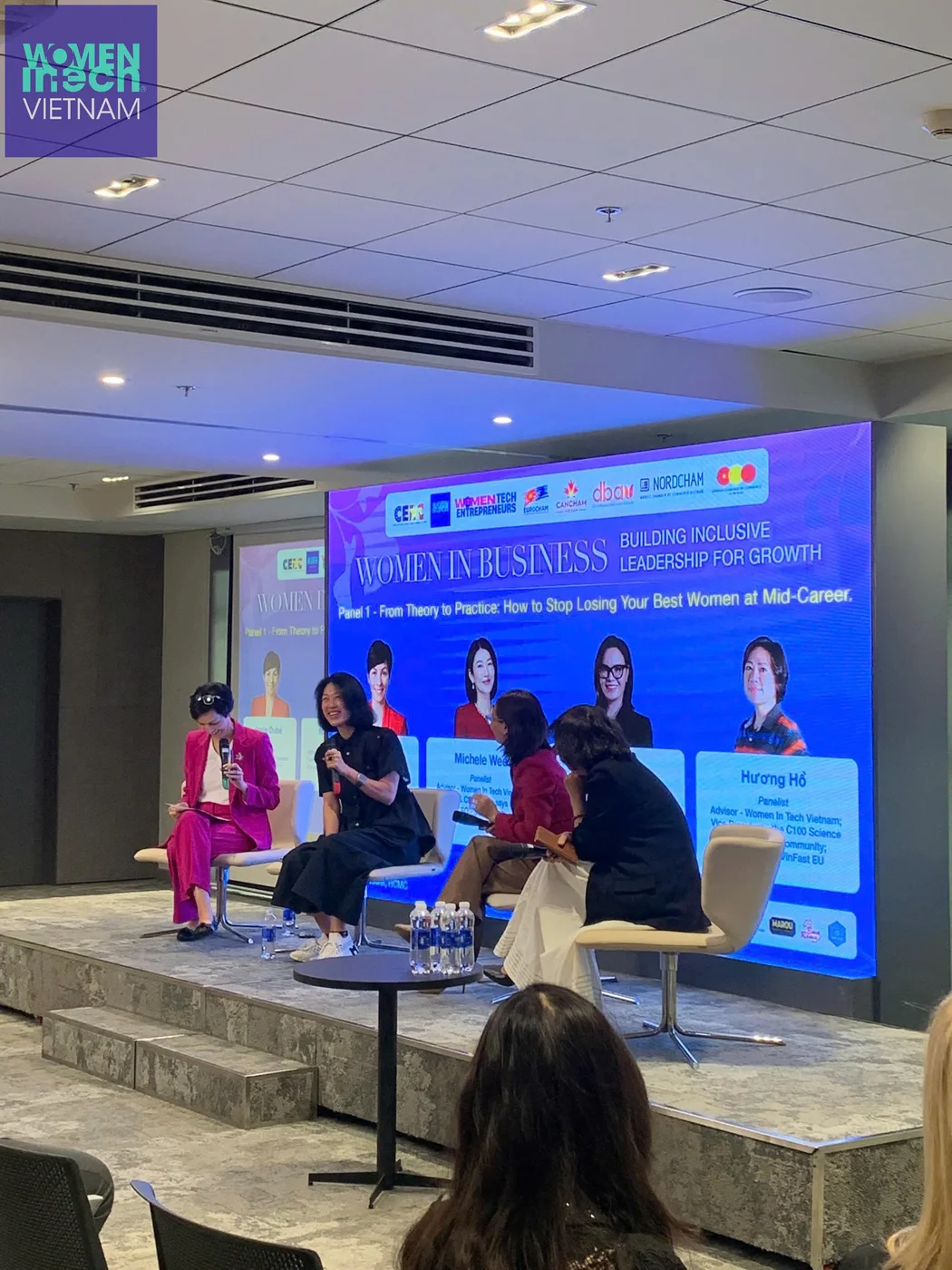
3. Finally, I really appreciated Ms. Huong Ho’s point that organizations need to create support networks that help women in the middle layer continue to grow upward, rather than being held back by invisible forces.
I added that to truly change this reality, transformation must happen top-down. Those at the very top must actively intervene in power structures so that women can participate in the highest levels of governance and management.
This is ultimately a matter of policy. Leaders saying “I support diversity and inclusion” on stage, or “I think you has potential to be in this position, so you can take it.” means very little. What truly matters is saying: “I support Ms. X for this role because she is a strong leader. If this project is complex, I want Ms. X to lead it.”
This must be accompanied by a real support network that ensures fairness - equity.
It is also important to distinguish between Equity and Equality.
Equality means giving everyone the same resources.
Equity means providing resources based on different needs so that everyone can achieve comparable outcomes.
Understanding this distinction is crucial when addressing gender issues — and many other social challenges.
I also shared my belief that women should keep a “winning diary” — a journal where we record our achievements. We should celebrate ourselves and encourage ourselves, because every win, big or small, matters and helps build confidence along our journey. And who is our longest cheerleader? Ourselves.
Finally, I suggested that organizations consider having a “Boasting Day” — a day when all members, regardless of gender, are given equal time to talk about their wins without shame or hesitation.
Only then can we avoid a system where those who speak loudly, confidently, and aggressively are the ones who advance, while those who work hard but speak less are disadvantaged. This harms not only individuals, but also organizations and the entire system.
In closing, our society — shaped by history, politics, and many forms of structural design — has created a world we are still actively working to make fairer. Whether we call this a revolution, a redesign, or simply moving with the flow of history toward progress, the essence remains the same.
History and science have shown that when women lead, the world benefits. When women sit at negotiation tables — in war or in business — agreements tend to last longer and commitments are more likely to be honored.
That said, change is not easy. We must understand the systems we operate within, recognize where we can exert influence, and accept where we cannot. With that understanding, we can remain patient, resilient — and most importantly, never give up hope or faith in what we believe in and choose to pursue.
Read more at: https://spokesmaster.substack.com/p/lam-the-nao-e-khong-e-mat-nhan-tai
![[Latest News] Vietnam Tops the World in Creative Goods Exports](https://vcystvqnqlquncjkhfqk.supabase.co/storage/v1/render/image/public/cm86yzxje006dqu90iz4rc2vg/Users/560777_imagejpeg?width=600&quality=80&resize=contain)
![[Latest News] CyberCon Asia 2025 Cybersecurity Event Discusses “AI versus AI”](https://vcystvqnqlquncjkhfqk.supabase.co/storage/v1/render/image/public/cm86yzxje006dqu90iz4rc2vg/Users/659822_imagejpeg?width=600&quality=80&resize=contain)
![[Events] Invitation to join the Women in Tech® Vietnam Delegation to the Women In Tech APAC Summit 2025](https://vcystvqnqlquncjkhfqk.supabase.co/storage/v1/render/image/public/cm86yzxje006dqu90iz4rc2vg/Users/26163_imagejpeg?width=600&quality=80&resize=contain)
![[Events] Advisory Board & Executive Board Regular Meeting of Women in Tech® Vietnam (WIT) and Women Tech Entrepreneurs (WTE)](https://vcystvqnqlquncjkhfqk.supabase.co/storage/v1/render/image/public/cm86yzxje006dqu90iz4rc2vg/Users/897421_imagejpeg?width=600&quality=80&resize=contain)
![[Latest News] Vietnam’s Growing Prominence in Cybersecurity: Host of ACM AsiaCCS 2025](https://vcystvqnqlquncjkhfqk.supabase.co/storage/v1/render/image/public/cm86yzxje006dqu90iz4rc2vg/Users/8666_imagejpeg?width=600&quality=80&resize=contain)
![[Latest News] Ho Chi Minh City’s Innovation Startup Center Opens as New Ecosystem Hub](https://vcystvqnqlquncjkhfqk.supabase.co/storage/v1/render/image/public/cm86yzxje006dqu90iz4rc2vg/Users/523193_imagejpeg?width=600&quality=80&resize=contain)
![[Events] The Art of Sake: Connecting Businesses & Cultures](https://vcystvqnqlquncjkhfqk.supabase.co/storage/v1/render/image/public/cm86yzxje006dqu90iz4rc2vg/Users/210348_imagejpeg?width=600&quality=80&resize=contain)
![[Knowledge & Skills] The Rise of “Big but Lean” Companies in the AI Era](https://vcystvqnqlquncjkhfqk.supabase.co/storage/v1/render/image/public/cm86yzxje006dqu90iz4rc2vg/Users/568389_imagejpeg?width=600&quality=80&resize=contain)
![[Latest News] Proud to Announce: Ms. Quyen Nguyen Joins as Event Ambassador for Tech in Asia AMPED 2025 Vietnam](https://vcystvqnqlquncjkhfqk.supabase.co/storage/v1/render/image/public/cm86yzxje006dqu90iz4rc2vg/Users/317446_imagejpeg?width=600&quality=80&resize=contain)
![[Knowledge & Skills] 10 Skills to Include on a CV in 2025](https://vcystvqnqlquncjkhfqk.supabase.co/storage/v1/render/image/public/cm86yzxje006dqu90iz4rc2vg/Users/39740_imagejpeg?width=600&quality=80&resize=contain)